Minggu, 20 Maret 2016

The Machu Picchu

Machu Picchu (in hispanicized spelling, Spanish pronunciation: [ˈmatʃu ˈpiktʃu]) or Machu Pikchu (Quechua machu old, old person, pikchu peak; mountain or prominence with a broad base which ends in sharp peaks,[1] "old peak", pronunciation [ˈmɑtʃu ˈpixtʃu]) is a 15th-century Inca site located 2,430 metres (7,970 ft) above sea level.[2][3] It is located in the Cusco Region, Urubamba Province, Machupicchu District in Peru.[4]
It is situated on a mountain ridge above the Sacred Valley which is 80 kilometres (50 mi) northwest of Cuzco and through which the Urubamba River flows. Most archaeologists believe that Machu Picchu was built as an estate for the Inca emperor Pachacuti (1438–1472). Often mistakenly referred to as the "Lost City of the Incas" (a title more accurately applied to Vilcabamba), it is the most familiar icon of Inca civilization.
The Incas built the estate around 1450, but abandoned it a century later at the time of the Spanish Conquest. Although known locally, it was not known to the Spanish during the colonial period and remained unknown to the outside world before being brought to international attention in 1911 by the American historian Hiram Bingham. Most of the outlying buildings have been reconstructed in order to give tourists a better idea of what the structures originally looked like.[5] By 1976, 30% of Machu Picchu had been restored;[5] restoration continues today.[6]
Machu Picchu was declared a Peruvian Historical Sanctuary in 1981 and a UNESCO World Heritage Site in 1983.[3] In 2007, Machu Picchu was voted one of the New Seven Wonders of the World in a worldwide Internet poll.
Machu Picchu was built in the classical Inca style, with polished dry-stone walls. Its three primary structures are the Inti Watana, the Temple of the Sun, and the Room of the Three Windows.

History
Machu Picchu was built around 1450, at the height of the Inca Empire.[7] Its construction appears to date to the period of the two great Incas, Pachacutec Inca Yupanqui (1438–71) and Tupac Inca Yupanqui (1472–93).[8] It was abandoned just over 100 years later, in 1572, as a belated result of the Spanish Conquest.[7][9]
It is possible that most of its inhabitants died from smallpox introduced by travellers before the Spanish conquistadors arrived in the area.[10] The conquistadors had notes of a place called Piccho, although there is no record of the Spanish having visited the remote city. The types of sacred rocks defaced by the conquistadors in other locations are untouched at Machu Picchu.[9]
The site may have been discovered and plundered in 1867 by a German businessman, Augusto Berns.[11] There is some evidence that a German engineer, J. M. von Hassel, arrived earlier. Maps found by historians show references to Machu Picchu as early as 1874.[12]
Although the citadel is located only about 80 kilometers (50 mi) from Cusco, the Inca capital, the Spanish never found it and so did not plunder or destroy it, as they did many other sites.[9] Over the centuries, the surrounding jungle grew over the site, and few outside the immediate area knew of its existence.
Hiram Bingham was an American historian and lecturer at Yale University, although not a trained archaeologist. In 1909, returning from the Pan-American Scientific Congress in Santiago, he traveled through Peru and was invited to explore the Inca ruins at Choqquequirau in the Apurimac Valley. He organized the 1911 Yale Peruvian Expedition with one of its objectives to search for the last capital of the Incas. He in fact, guided by locals, rediscovered and correctly identified both Vitcos (then called Rosaspata) and Vilcabamba (then called Espíritu Pampa), which he named "Eromboni Pampa".[13] However, he did not correctly recognize Vilcabamba as the last capital, instead continuing onward and misidentifying Machu Picchu as the "Lost City of the Incas", as his book titled it. Further expeditions focused on Machu Picchu, neglecting further investigation of Vitcos and Vilcabamba. Machu Picchu was built at the height of the Inca Empire, and thus features spectacular workmanship and a dramatic site, while the actual last capital of Vilcabamba was built while the short-lived remnant Neo-Inca State was being vanquished by the Spanish, and thus features crude workmanship.
Bingham asked a Peruvian farmer and innkeeper, Melchor Arteaga, if he knew of any ruins in the area.[14] The next day, 24 July 1911, Arteaga led Bingham and Sergeant Carrasco across the river on a primitive log bridge and up the Huayna Picchu mountain. At the top of the mountain they came across a small hut occupied by a couple of Quechua, Richarte and Alvarez, who were farming some of the original Machu Picchu agricultural terraces that they had cleared four years earlier. Alvarez's 11-year-old son, Pablito, led Bingham along the ridge to the main ruins.[15]
During Bingham's archaeological studies, he collected various artifacts which he took back to Yale. One prominent artifact was a set of 15th-century, ceremonial Incan knives made from bismuth bronze; they are the earliest known artifact containing this alloy.[16]
Although local institutions initially welcomed the exploration supplementing knowledge about Peruvian ancestry, they soon accused Bingham of legal and cultural malpractice.[17] Rumors arose that the team was stealing artifacts and smuggling them out of Peru through the bordering country of Bolivia. (In fact, Bingham removed many artifacts, but openly and legally; they were deposited in the Yale University Museum.) Local press perpetuated the accusations, claimed that the excavation harmed the site and deprived local archaeologists of knowledge about their own history.[17] Landowners began to demand rent from the excavators.[17] By the time Bingham and his team left Machu Picchu, locals began forming coalitions to defend their ownership of Machu Picchu and its cultural remains, while Bingham claimed the artifacts ought to be studied by experts in American institutions, an argument that still exists today.[17]
In 1964, Gene Savoy did further exploration of the ruins at Espiritu Pampa and revealed the full extent of the site, identifying it as Vilcabamba Viejo where the Incas fled to after the Spanish drove them from Vitcos.[18]
In 1981, Peru declared an area of 325.92 square kilometres (125.84 sq mi) surrounding Machu Picchu a "Historical Sanctuary". In addition to the ruins, the sanctuary includes a large portion of the adjoining region, rich with the flora and fauna of the Peruvian Yungas and Central Andean wet puna ecoregions.[19]
In 1983, UNESCO designated Machu Picchu a World Heritage Site, describing it as "an absolute masterpiece of architecture and a unique testimony to the Inca civilization".

 

The Eiffel Tower

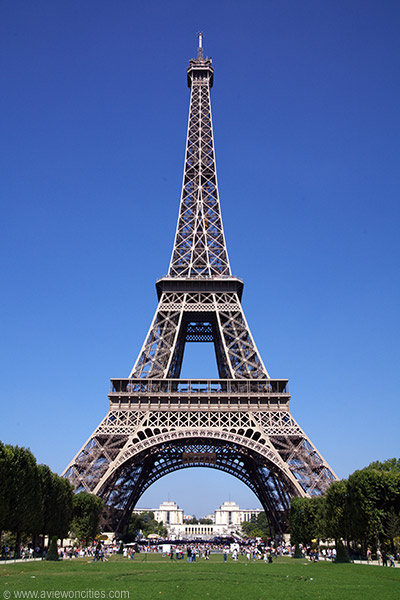
The Eiffel Tower is a wrought iron lattice tower on the Champ de Mars in Paris, France. It is named after the engineer Gustave Eiffel, whose company designed and built the tower. Constructed in 1889 as the entrance to the 1889 World's Fair, it was initially criticized by some of France's leading artists and intellectuals for its design, but has become a global cultural icon of France and one of the most recognisable structures in the world.[2] The tower is the tallest structure in Paris and the most-visited paid monument in the world: 6.98 million people ascended it in 2011.[3] The tower received its 250 millionth visitor in 2010.[3]
The tower is 324 metres (1,063 ft) tall,[3] about the same height as an 81-storey building. Its base is square, 125 metres (410 ft) on a side. During its construction, the Eiffel Tower surpassed the Washington Monument to become the tallest man-made structure in the world, a title it held for 41 years until the Chrysler Building in New York City was built in 1930. Due to the addition of the aerial at the top of the tower in 1957, it is now taller than the Chrysler Building by 5.2 metres (17 ft). Not including broadcast aerials, it is the second-tallest structure in France, after the Millau Viaduct.
The tower has three levels for visitors, with restaurants on the first and second. The top level's upper platform is 276 m (906 ft) above the ground,[3] the highest accessible to the public in the European Union. Tickets can be purchased to ascend by stairs or lift (elevator) to the first and second levels. The climb from ground level to the first level is over 300 steps, as is the climb from the first level to the second. Although there is a staircase to the top level, it is usually only accessible by lift.

History
Origin
The design of the Eiffel Tower was the product of Maurice Koechlin and Émile Nouguier, two senior engineers working for the Compagnie des Établissements Eiffel, after discussion about a suitable centrepiece for the proposed 1889 Exposition Universelle, a world's fair to celebrate the centennial of the French Revolution. Eiffel openly acknowledged that inspiration for a tower came from the Latting Observatory built in New York City in 1853.[4] In May 1884, working at home, Koechlin made a sketch of their idea, described by him as "a great pylon, consisting of four lattice girders standing apart at the base and coming together at the top, joined together by metal trusses at regular intervals".[5] Eiffel initially showed little enthusiasm, but he did approve further study, and the two engineers then asked Stephen Sauvestre, the head of company's architectural department, to contribute to the design. Sauvestre added decorative arches to the base of the tower, a glass pavilion to the first level, and other embellishments.
The new version gained Eiffel's support: he bought the rights to the patent on the design which Koechlin, Nougier, and Sauvestre had taken out, and the design was exhibited at the Exhibition of Decorative Arts in the autumn of 1884 under the company name. On 30 March 1885, Eiffel presented his plans to the Société des Ingénieurs Civils; after discussing the technical problems and emphasising the practical uses of the tower, he finished his talk by saying the tower would symbolise,
"Not only the art of the modern engineer, but also the century of Industry and Science in which we are living, and for which the way was prepared by the great scientific movement of the eighteenth century and by the Revolution of 1789, to which this monument will be built as an expression of France's gratitude."[6]
Little progress was made until 1886, when Jules Grévy was re-elected as president of France and Édouard Lockroy was appointed as minister for trade. A budget for the exposition was passed and, on 1 May, Lockroy announced an alteration to the terms of the open competition being held for a centerpiece to the exposition, which effectively made the selection of Eiffel's design a foregone conclusion, as entries had to include a study for a 300 m (980 ft) four-sided metal tower on the Champ de Mars.[6] On 12 May, a commission was set up to examine Eiffel's scheme and its rivals, which, a month later, decided that all the proposals except Eiffel's were either impractical or lacking in details.
After some debate about the exact location of the tower, a contract was signed on 8 January 1887. This was signed by Eiffel acting in his own capacity rather than as the representative of his company, and granted him 1.5 million francs toward the construction costs: less than a quarter of the estimated 6.5 million francs. Eiffel was to receive all income from the commercial exploitation of the tower during the exhibition and for the next 20 years. He later established a separate company to manage the tower, putting up half the necessary capital himself.

Construction

Work on the foundations started on 28 January 1887.[15] Those for the east and south legs were straightforward, with each leg resting on four 2 m (6.6 ft) concrete slabs, one for each of the principal girders of each leg. The west and north legs, being closer to the river Seine, were more complicated: each slab needed two piles installed by using compressed-air caissons 15 m (49 ft) long and 6 m (20 ft) in diameter driven to a depth of 22 m (72 ft)[16] to support the concrete slabs, which were 6 m (20 ft) thick. Each of these slabs supported a block of limestone with an inclined top to bear a supporting shoe for the ironwork.
Each shoe was anchored to the stonework by a pair of bolts 10 cm (4 in) in diameter and 7.5 m (25 ft) long. The foundations were completed on 30 June, and the erection of the ironwork began. The visible work on-site was complemented by the enormous amount of exacting preparatory work that took place behind the scenes: the drawing office produced 1,700 general drawings and 3,629 detailed drawings of the 18,038 different parts needed.[17] The task of drawing the components was complicated by the complex angles involved in the design and the degree of precision required: the position of rivet holes was specified to within 0.1 mm (0.004 in) and angles worked out to one second of arc. The finished components, some already riveted together into sub-assemblies, arrived on horse-drawn carts from a factory in the nearby Parisian suburb of Levallois-Perret and were first bolted together, with the bolts being replaced with rivets as construction progressed. No drilling or shaping was done on site: if any part did not fit, it was sent back to the factory for alteration. In all, 18,038 pieces were joined together using 2.5 million rivets.[15]
At first the legs were constructed as cantilevers, but about halfway to the first level, construction was paused in order to create a substantial timber scaffold. This renewed concerns about the structural integrity of the tower, and sensational headlines such as "Eiffel Suicide!" and "Gustave Eiffel Has Gone Mad: He Has Been Confined in an Asylum" appeared in the tabloid press.[18] At this stage, a small "creeper" crane designed to move up the tower was installed in each leg. They made use of the guides for the lifts which were to be fitted in the four legs. The critical stage of joining the legs at the first level was completed by the end of March 1888.[15] Although the metalwork had been prepared with the utmost attention to detail, provision had been made to carry out small adjustments in order to precisely align the legs; hydraulic jacks were fitted to the shoes at the base of each leg, capable of exerting a force of 800 tonnes, and the legs were intentionally constructed at a slightly steeper angle than necessary, being supported by sandboxes on the scaffold. Although construction involved 300 on-site employees,[15] only one person died thanks to Eiffel's stringent safety precautions and the use of movable gangways, guardrails and screens.


All About Sphinx

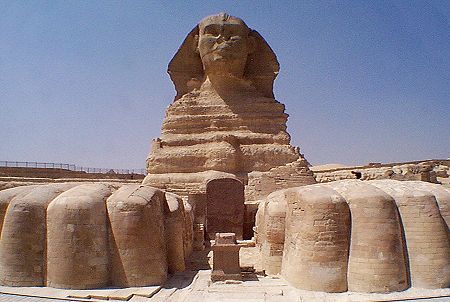
 The sphinx is a mythical creature with, as a minimum, the head of a human and the body of a lion.
In Greek tradition, it has the head of a human, the haunches of a lion, and sometimes the wings of a bird. It is mythicised as treacherous and merciless. Those who cannot answer its riddle suffer a fate typical in such mythological stories, as they are killed and eaten by this ravenous monster.[1] This deadly version of a sphinx appears in the myth and drama of Oedipus.[2] Unlike the Greek sphinx, which was a woman, the Egyptian sphinx is typically shown as a man (an androsphinx). In addition, the Egyptian sphinx was viewed as benevolent, but having a ferocious strength similar to the malevolent Greek version and both were thought of as guardians often flanking the entrances to temples.[3]
In European decorative art, the sphinx enjoyed a major revival during the Renaissance. Later, the sphinx image, something very similar to the original Ancient Egyptian concept, was exported into many other cultures, albeit often interpreted quite differently due to translations of descriptions of the originals and the evolution of the concept in relation to other cultural traditions.
Sphinxes are generally associated with architectural structures such as royal tombs or religious temples. The oldest known sphinx was found near Gobekli Tepe at another site, Nevali Çori,[4] or possibly 120 miles to the east at Kortik Tepe, Turkey, and was dated to 9,500 BCE.

Egyptian sphinxes

The largest and most famous sphinx is the Great Sphinx of Giza, situated on the Giza Plateau adjacent to the Great Pyramids of Giza on the west bank of the Nile River and facing east (29°58′31″N 31°08′15″E). The sphinx is located southeast of the pyramids. Although the date of its construction is uncertain, the head of the Great Sphinx now is believed to be that of the pharaoh Khafra.
What names their builders gave to these statues is not known. At the Great Sphinx site, the inscription on a stele by Thutmose IV in 1400 BCE, lists the names of three aspects of the local sun deity of that period, KheperaAtum. The inclusion of these figures in tomb and temple complexes quickly became traditional and many pharaohs had their heads carved atop the guardian statues for their tombs to show their close relationship with the powerful solar deity, Sekhmet, a lioness. Other famous Egyptian sphinxes include one bearing the head of the pharaoh Hatshepsut, with her likeness carved in granite, which is now in the Metropolitan Museum of Art in New York, and the alabaster sphinx of Memphis, Memphis, Egypt, currently located within the open-air museum at that site. The theme was expanded to form great avenues of guardian sphinxes lining the approaches to tombs and temples as well as serving as details atop the posts of flights of stairs to very grand complexes. Nine hundred with ram heads, representing Amon, were built in Thebes, where his cult was strongest.
Perhaps the first sphinx in Egypt was one depicting Queen Hetepheres II, of the fourth dynasty that lasted from 2723 BCE to 2563. She was one of the longest-lived members of the royal family of that dynasty.[citation needed]
The Great Sphinx has become an emblem of Egypt, frequently appearing on its stamps, coins, and official documents.

Senin, 29 Februari 2016

Karnak Temple : The Biggest Temple


Karnak-Hypostyle3.jpg

The Karnak Temple Complex, commonly known as Karnak (/ˈkɑːr.næk/[1]), comprises a vast mix of decayed temples, chapels, pylons, and other buildings. Building at the complex began during the reign of Senusret I in the Middle Kingdom and continued into the Ptolemaic period, although most of the extant buildings date from the New Kingdom. The area around Karnak was the ancient Egyptian Ipet-isut ("The Most Selected of Places") and the main place of worship of the eighteenth dynasty Theban Triad with the god Amun as its head. It is part of the monumental city of Thebes. The Karnak complex gives its name to the nearby, and partly surrounded, modern village of El-Karnak, 2.5 kilometres (1.6 miles) north of Luxor. Also, Karnak was a high-precision ancient observatory according to Norman Lockyer.[2]

Overview


Great hall, Karnak. Brooklyn Museum Archives, Goodyear Archival Collection
The complex is a vast open-air museum, and the second largest ancient religious site in the world, after the Angkor Wat Temple of Cambodia. It is believed to be the second most visited historical site in Egypt; only the Giza Pyramids near Cairo receive more visits. It consists of four main parts, of which only the largest is currently open to the general public. The term Karnak often is understood as being the Precinct of Amun-Ra only, because this is the only part most visitors see. The three other parts, the Precinct of Mut, the Precinct of Montu, and the dismantled Temple of Amenhotep IV, are closed to the public. There also are a few smaller temples and sanctuaries connecting the Precinct of Mut, the Precinct of Amun-Re, and the Luxor Temple.
The Precinct of Mut is very ancient, being dedicated to an Earth and creation deity, but not yet restored. The original temple was destroyed and partially restored by Hatshepsut, although another pharaoh built around it in order to change the focus or orientation of the sacred area. Many portions of it may have been carried away for use in other buildings.
The key difference between Karnak and most of the other temples and sites in Egypt is the length of time over which it was developed and used. Construction of temples started in the Middle Kingdom and continued through to Ptolemaic times. Approximately thirty pharaohs contributed to the buildings, enabling it to reach a size, complexity, and diversity not seen elsewhere. Few of the individual features of Karnak are unique, but the size and number of features are overwhelming. The deities represented range from some of the earliest worshiped to those worshiped much later in the history of the Ancient Egyptian culture. Although destroyed, it also contained an early temple built by Amenhotep IV (Akhenaten), the pharaoh who later would celebrate a near monotheistic religion he established that prompted him to move his court and religious center away from Thebes. It also contains evidence of adaptations, using buildings of the Ancient Egyptians by later cultures for their own religious purposes.
One famous aspect of Karnak is the Hypostyle Hall in the Precinct of Amun-Re, a hall area of 50,000 sq ft (5,000 m2) with 134 massive columns arranged in 16 rows. 122 of these columns are 10 meters tall, and the other 12 are 21 meters tall with a diameter of over three meters.
The architraves on top of these columns are estimated to weigh 70 tons. These architraves may have been lifted to these heights using levers. This would be an extremely time-consuming process and also would require great balance to get to such great heights. A common alternative theory regarding how they were moved is that large ramps were constructed of sand, mud, brick or stone and that the stones were then towed up the ramps. If stone had been used for the ramps, they would have been able to use much less material. The top of the ramps presumably would have employed either wooden tracks or cobblestones for towing the megaliths.
There is an unfinished pillar in an out-of-the-way location that indicates how it would have been finished. Final carving was executed after the drums were put in place so that it was not damaged while being placed.[3][4] Several experiments moving megaliths with ancient technology were made at other locations – some of them are listed here.
In 2009 UCLA launched a website dedicated to virtual reality digital reconstructions of the Karnak complex and other resources.[5]
The sun god's shrine has light focused upon it during the solstice.[6]

All About Abu Simbel Temple


Panorama Abu Simbel crop.jpg

The Abu Simbel temples are two massive rock temples at Abu Simbel (أبو سمبل in Arabic), a village in Nubia, southern Egypt, near the border with Sudan. They are situated on the western bank of Lake Nasser, about 230 km southwest of Aswan (about 300 km by road). The complex is part of the UNESCO World Heritage Site known as the "Nubian Monuments,"[1] which run from Abu Simbel downriver to Philae (near Aswan). The twin temples were originally carved out of the mountainside during the reign of Pharaoh Ramesses II in the 13th century BC, as a lasting monument to himself and his queen Nefertari, to commemorate his victory at the Battle of Kadesh. Their huge external rock relief figures have become iconic.
The complex was relocated in its entirety in 1968, on an artificial hill made from a domed structure, high above the Aswan High Dam reservoir. The relocation of the temples was necessary to prevent their being submerged during the creation of Lake Nasser, the massive artificial water reservoir formed after the building of the Aswan High Dam on the Nile River.

History

Construction

Construction of the temple complex started in approximately 1264 BC and lasted for about 20 years, until 1244 BC. Known as the "Temple of Ramesses, beloved by Amun" it was one of six rock temples erected in Nubia during the long reign of Ramesses II. Their purpose was to impress Egypt's southern neighbours, and also to reinforce the status of Egyptian religion in the region. Historians say that the design of Abu Simbel expresses a measure of ego and pride in Ramesses II.

Rediscovery

With the passage of time, the temples fell into disuse and eventually became covered by sand. Already in the 6th century BC, the sand covered the statues of the main temple up to their knees. The temple was forgotten until 1813, when Swiss orientalist Jean-Louis Burckhardt found the top frieze of the main temple. Burckhardt talked about his discovery with Italian explorer Giovanni Belzoni, who travelled to the site, but was unable to dig out an entry to the temple. Belzoni returned in 1817, this time succeeding in his attempt to enter the complex. A detailed early description of the temples, together with contemporaneous line drawings, can be found in Edward William Lane's Description of Egypt (1825-1828).[2]
Tour guides at the site relate the legend that "Abu Simbel" was a young local boy who guided these early re-discoverers to the site of the buried temple which he had seen from time to time in the shifting sands. Eventually, they named the complex after him.

All About Pyramid Giza

The Great Pyramid of Giza (also known as the Pyramid of Khufu or the Pyramid of Cheops) is the oldest and largest of the three pyramids in the Giza pyramid complex bordering what is now El Giza, Egypt. It is the oldest of the Seven Wonders of the Ancient World, and the only one to remain largely intact.
Based on a mark in an interior chamber naming the work gang and a reference to fourth dynasty Egyptian Pharaoh Khufu,[1][2] Egyptologists believe that the pyramid was built as a tomb over a 10 to 20-year period concluding around 2560 BC. Initially at 146.5 metres (481 feet), the Great Pyramid was the tallest man-made structure in the world for more than 3,800 years. Originally, the Great Pyramid was covered by casing stones that formed a smooth outer surface; what is seen today is the underlying core structure. Some of the casing stones that once covered the structure can still be seen around the base. There have been varying scientific and alternative theories about the Great Pyramid's construction techniques. Most accepted construction hypotheses are based on the idea that it was built by moving huge stones from a quarry and dragging and lifting them into place.
There are three known chambers inside the Great Pyramid. The lowest chamber is cut into the bedrock upon which the pyramid was built and was unfinished. The so-called[3] Queen's Chamber and King's Chamber are higher up within the pyramid structure. The main part of the Giza complex is a setting of buildings that included two mortuary temples in honour of Khufu (one close to the pyramid and one near the Nile), three smaller pyramids for Khufu's wives, an even smaller "satellite" pyramid, a raised causeway connecting the two temples, and small mastaba tombs surrounding the pyramid for nobles.

History and Detail

It is believed the pyramid was built as a tomb for Fourth Dynasty Egyptian pharaoh Khufu (often Hellenicised as "Cheops") and was constructed over a 20-year period. Khufu's vizier, Hemon, or Hemiunu, is believed by some to be the architect of the Great Pyramid.[4] It is thought that, at construction, the Great Pyramid was originally 280 Egyptian cubits tall (146.5 metres (480.6 ft)), but with erosion and absence of its pyramidion, its present height is 138.8 metres (455.4 ft). Each base side was 440 cubits, 230.4 metres (755.9 ft) long. The mass of the pyramid is estimated at 5.9 million tonnes. The volume, including an internal hillock, is roughly 2,500,000 cubic metres (88,000,000 cu ft).[5] Based on these estimates, building the pyramid in 20 years would involve installing approximately 800 tonnes of stone every day. Additionally, since it consists of an estimated 2.3 million blocks, completing the building in 20 years would involve moving an average of more than 12 of the blocks into place each hour, day and night. The first precision measurements of the pyramid were made by Egyptologist Sir Flinders Petrie in 1880–82 and published as The Pyramids and Temples of Gizeh.[6] Almost all reports are based on his measurements. Many of the casing stones and inner chamber blocks of the Great Pyramid fit together with extremely high precision. Based on measurements taken on the northeastern casing stones, the mean opening of the joints is only 0.5 millimetre wide (1/50 of an inch).[7]
Great Pyramid of Giza from a 19th-century stereopticon card photo
The pyramid remained the tallest man-made structure in the world for over 3,800 years,[8] unsurpassed until the 160-metre-tall (520 ft) spire of Lincoln Cathedral was completed c. 1300. The accuracy of the pyramid's workmanship is such that the four sides of the base have an average error of only 58 millimetres in length.[9] The base is horizontal and flat to within ±15 mm (0.6 in).[10] The sides of the square base are closely aligned to the four cardinal compass points (within four minutes of arc)[11] based on true north, not magnetic north,[12] and the finished base was squared to a mean corner error of only 12 seconds of arc.[13] The completed design dimensions, as suggested by Petrie's survey and subsequent studies, are estimated to have originally been 280 royal cubits high by 440 cubits long at each of the four sides of its base. The ratio of the perimeter to height of 1760/280 royal cubits equates to 2π to an accuracy of better than 0.05% (corresponding to the well-known approximation of π as 22/7). Some Egyptologists consider this to have been the result of deliberate design proportion. Verner wrote, "We can conclude that although the ancient Egyptians could not precisely define the value of π, in practice they used it".[14] Petrie, author of Pyramids and Temples of Gizeh concluded: "but these relations of areas and of circular ratio are so systematic that we should grant that they were in the builder's design".[15] Others have argued that the Ancient Egyptians had no concept of pi and would not have thought to encode it in their monuments. They believe that the observed pyramid slope may be based on a simple seked slope choice alone, with no regard to the overall size and proportions of the finished building.[16]
In 2013 rolls of papyrus were discovered written by some people who delivered stone and other construction materials to Khufu's brother at Giza.[17]o